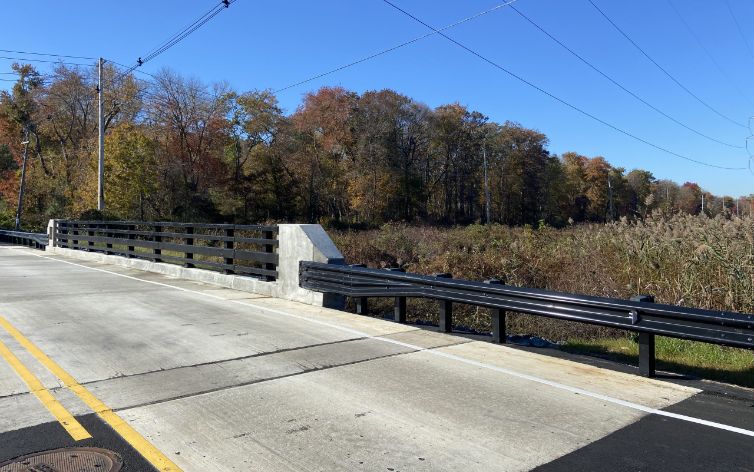
Box Beam Guiderail
Heavy-duty box beam guiderail for bridge approaches, high-risk curves, and locations requiring increased structural capacity.
Some roadside hazards demand more containment than standard W-beam can provide. Box beam guiderail delivers the structural rigidity needed at bridge approach transitions, tight horizontal curves, and locations where deflection space behind the rail is limited. Road Safety Systems installs box beam systems for highway agencies and general contractors across New York, New Jersey, Pennsylvania, Delaware, and Maryland.
Box Beam Systems
Box beam guiderail uses a rectangular hollow structural section (HSS) rail element mounted on steel posts with block-out spacers. The tubular profile provides significantly greater bending strength and rigidity than corrugated W-beam, allowing the system to redirect vehicles with less deflection — making it the preferred choice where clear zone behind the guiderail is limited. We also install nested box beam configurations for higher containment levels at bridge ends and locations with heavy truck traffic, and the transition sections that connect W-beam or Thrie-beam highway runs to box beam bridge approach sections.
Bridge Approach Applications
Much of our box beam work involves bridge approach guiderail — the critical stretch on each side of a bridge structure where guiderail transitions from flexible highway systems to rigid bridge rail. This transition zone is one of the most engineered sections of any highway project, and we install box beam approach rails and bridge rail transitions per state DOT bridge approach standard drawings, with verification measurements before, during, and after installation.
Where Box Beam Is Specified
Agencies across our service territory specify box beam guiderail at bridge approaches, sharp horizontal curves where deflection would push vehicles off embankments, high-fill sections, and interchange gore areas. Box beam costs more per foot than W-beam but is specified only where the engineering requires its higher performance.
Ready to Start Your Project?
Get a free, no-obligation quote from our team of highway safety infrastructure experts.
Key Features
- HSS rectangular tube rail profiles
- Reduced deflection for limited clear-zone locations
- Nested double-rail configurations for higher containment
- Precision bridge approach transitions
- DOT-approved end terminal systems
- Verification measurements at every splice
Applications
Technical Specifications
| Rail Profile | HSS rectangular tube |
| Post Type | Steel, per DOT standard drawings |
| Containment | TL-3 standard, nested configurations for TL-4/TL-5 |
| Deflection | Significantly less than standard W-beam |
Frequently Asked Questions
Request a Free Quote
We'll review your project and respond within 2 business hours.